
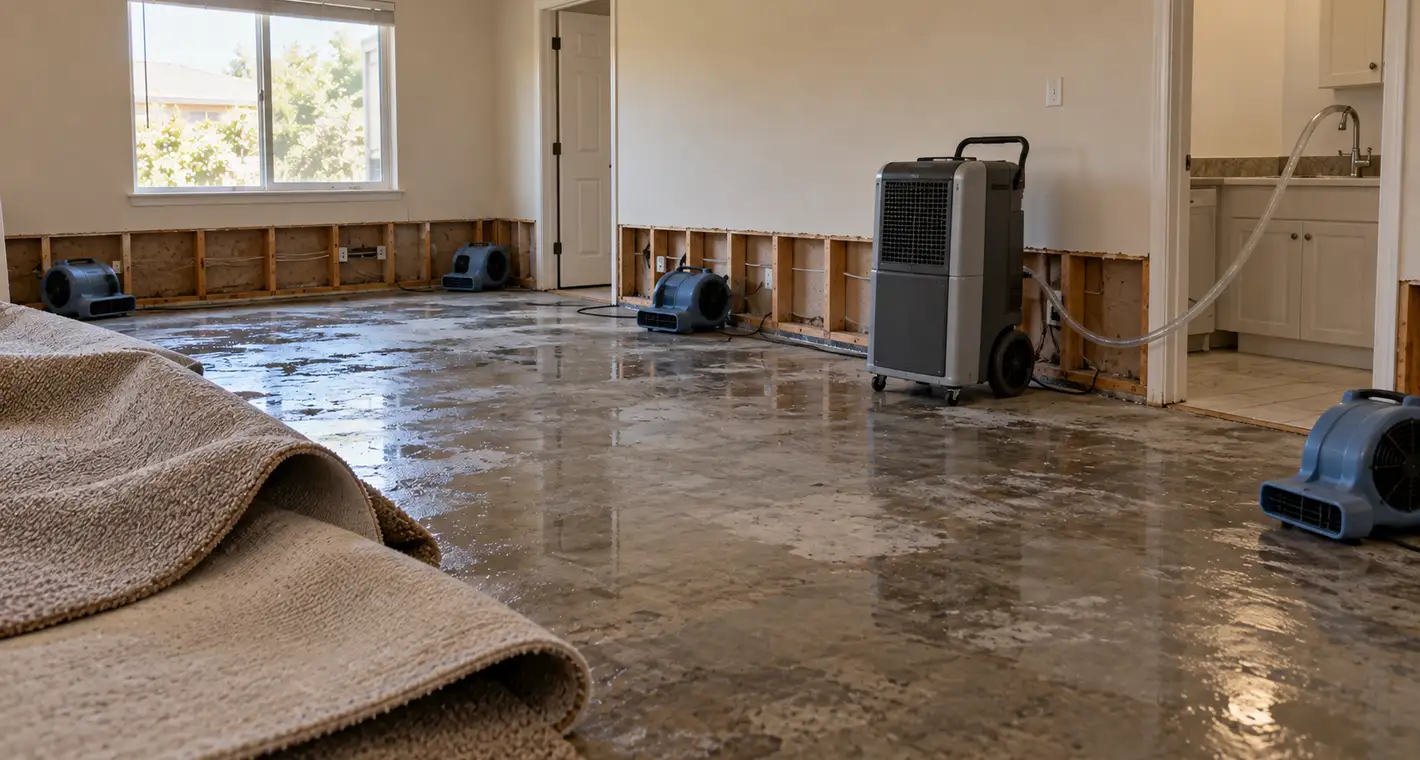
Water extraction Carson CA begins with bulk removal
Nothing else moves quickly while there is standing water on the floor, and the wet area keeps growing the whole time. So bulk removal comes first, with equipment that draws water out of carpet and padding under vacuum instead of picking it up off the surface. On hard flooring the question is what has already gone underneath, through the seams in vinyl and laminate and into whatever is below.
How much comes out mechanically decides how long the rest takes. Every gallon extracted is a gallon that does not have to be evaporated into the air and then condensed back out of it, which is much the slower route. On a slab house that difference is larger than it looks, because the concrete under the finish floor will keep handing moisture back for days.
What structural drying does in a slab house
A building stores water in its materials rather than only on its surfaces. Drywall, framing, subfloor, insulation, plaster and concrete all take it up and give it back slowly. Structural drying is the controlled work of bringing those materials back to the moisture level that is normal for that particular building, which is not the same number in a 1929 house in Malaga Cove and a 1966 tract house in Carson.
Air movers are placed to break the thin film of still, saturated air that forms against a wet surface. Until that film is disturbed evaporation nearly stops, which is why a wet floor in a shut room can stay wet for days. Dehumidifiers then take the released moisture out of the air. Without them the humidity in the room climbs and the water simply relocates into materials that were dry, carrying the problem into rooms that were never touched.
Where water has gone into a wall cavity, drying the face of the wall does nothing for the inside of it. Cavities are dried through directed airflow at the base of the wall, through small inspection openings, or by taking off a band of drywall where there is no other way to reach the assembly.
Measurement rather than guesswork
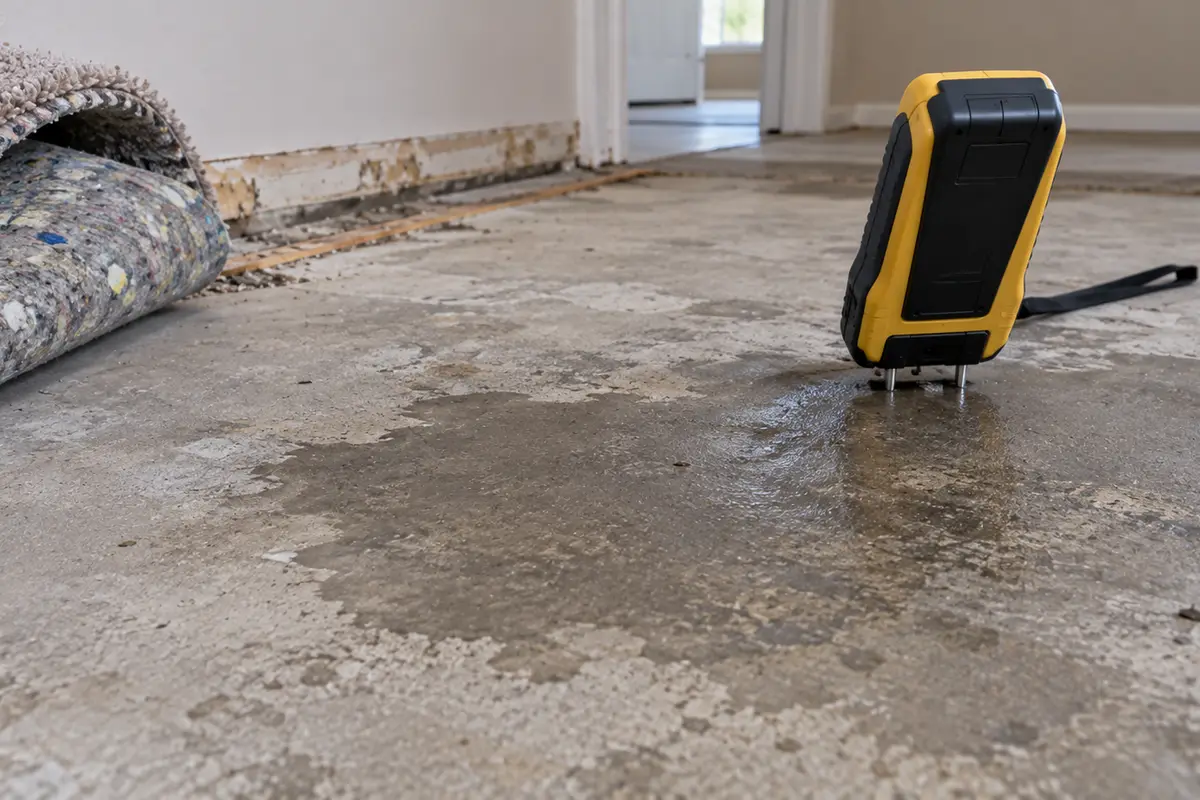
Meters are used on the affected material and on the same material elsewhere in the house where it stayed dry. That second reading sets the baseline for that structure, and baselines differ sharply across this service area: plaster over wood lath in a pre-war Palos Verdes Estates or Compton house behaves nothing like drywall over a post-war slab in Torrance, and a raised wood floor holds and releases water differently from concrete. Thermal imaging helps show where water traveled, but it reads temperature rather than moisture and is used to aim the meter, not to replace it.
Moisture readings are logged on each visit and the equipment stays until the affected numbers come back to baseline. For a contained loss caught the same day that is commonly three to five days. Plaster, hardwood and concrete hold water considerably longer and can run a week or more.
What gets dried and what gets removed
Clean water caught quickly lets most of the structure dry in place. Carpet padding usually comes out anyway, because it holds a great deal of water and dries slowly enough to keep the carpet above it wet. Where the water was contaminated, or where material has been saturated long enough that it will not return to shape, removal replaces drying. Saturated insulation is the common example: it stops insulating and holds water against the framing.
Water extraction and drying by city
- Water Extraction CarsonZIP 90745, 90746
- Water Extraction TorranceZIP 90501, 90503, 90504, 90505
- Water Extraction Rancho Palos VerdesZIP 90275
- Water Extraction ComptonZIP 90220, 90221, 90222
- Water Extraction Manhattan BeachZIP 90266
- Water Extraction Palos Verdes EstatesZIP 90274
- Water Extraction West CarsonZIP 90502
- Water Extraction Rolling Hills EstatesZIP 90274
- Water Extraction Rolling HillsZIP 90274
Water extraction Carson CA: common questions
- How is extraction different from mopping or shop-vacuuming?
- Extraction units pull water out of carpet and padding under vacuum rather than lifting it off the surface. Most of the water in a carpeted room sits in the padding beneath, and surface methods leave it there. A shop vacuum also has no way to reach water that has already gone under the tack strip into the base of the wall, which on a slab floor is where most of it ends up.
- Why do dehumidifiers matter if the air movers are already running?
- Air movers move moisture out of materials and into the air. If nothing takes it out of the air, humidity in the room climbs and that moisture goes back into materials that were previously dry, including furniture and adjacent rooms. Dehumidification is what actually removes water from the building. The two run together, and neither does the job alone.
- Does the marine layer make drying harder here?
- It rules out one shortcut. Coastal air in this area carries a lot of moisture through late spring and early summer, so opening windows and doors brings damp air into a wet house rather than drying it. Equipment runs on a closed building instead, with dehumidifiers taking water out of the air inside. Inland heat in September does not change that either, because a wall cavity does not follow the weather.
- How is drying confirmed rather than assumed?
- Meters are used on the affected material and on the same material elsewhere in the building where it stayed dry, which establishes what normal is for that structure. Readings are logged each visit. Equipment stays until the affected readings match that baseline, so the schedule follows the numbers rather than a fixed number of days.
- Can equipment be pulled early to save on cost?
- It can be, and it moves the problem rather than ending it. Material left above normal moisture keeps holding water inside the assembly, and that is the condition growth starts in. Stopping drying early is the most common reason a loss that looked finished comes back as a second problem a month later, usually as a smell before anything is visible.