
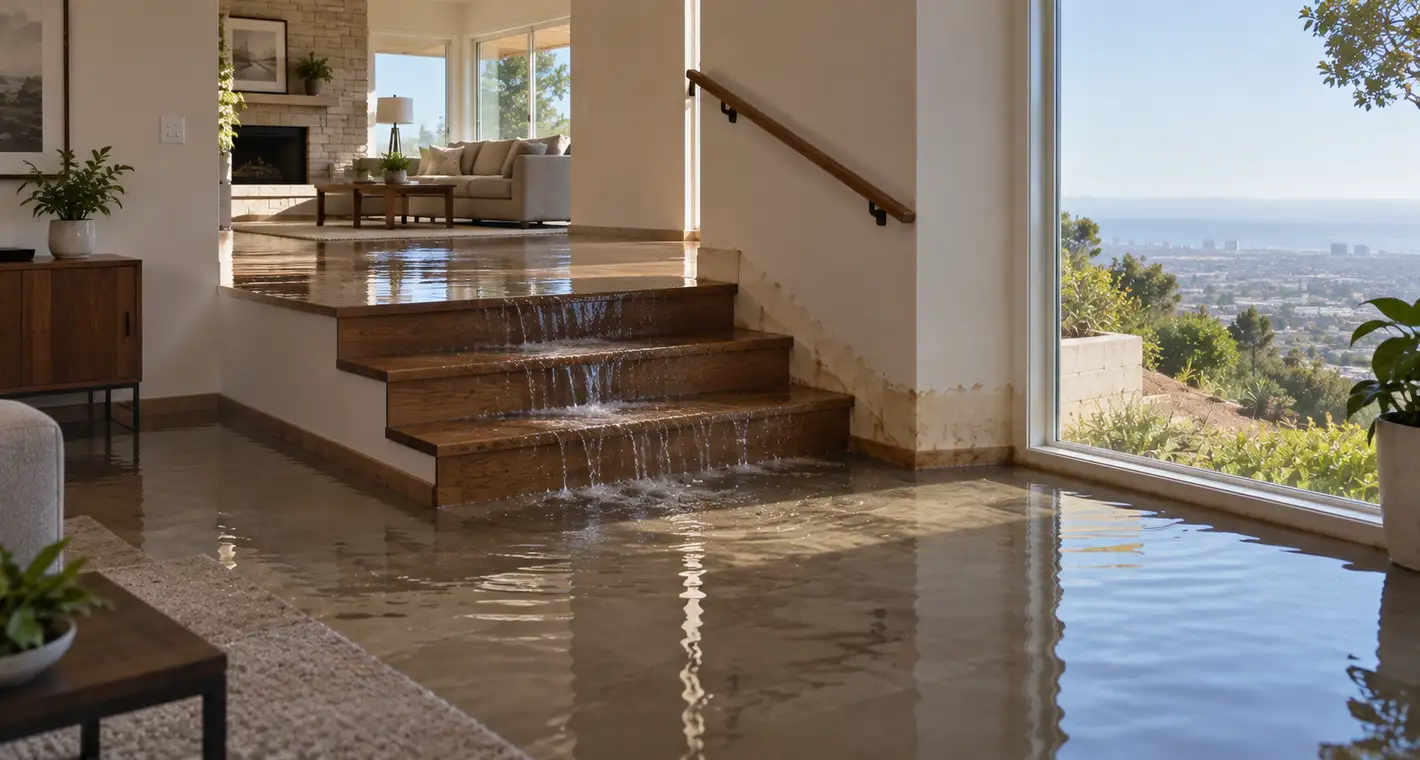
Water damage restoration Rolling Hills CA and a private city
Rolling Hills is a gated city of just under 700 homes spread across roughly three square miles of ridge and canyon on the crown of the peninsula. Three guarded gates control the only ways in, at Portuguese Bend Road, Eastfield and Crest Road West, and more than 25 miles of private bridle trails run between the properties. Zoning here sets a one-acre minimum in RAS-1 and two acres in RAS-2, and many parcels are larger still. The housing is overwhelmingly mid-century ranch: 45.1 percent of it was built in the 1950s, the heaviest single-decade concentration of any city on this list, and the median year is 1960.
Before help arrives
- Shut the water off at the fixture or the main if you can reach it safely.
- Keep out of any room where water has reached outlets, cords, or the electrical panel.
- Lift furniture off wet carpet and move what you can to a dry floor.
- Photograph the damage and the failure point before anything is moved.
- Do not use a household vacuum to pick up standing water.
Burst pipe cleanup Rolling Hills: four failures behind the gates
Private septic rather than city sewer
Most homes in Rolling Hills are on their own septic system rather than a public sewer. When a leach field saturates, whether from winter rain or from a supply leak feeding it, the system stops accepting flow and the backup comes up at the drain closest to the floor inside the house. That is contaminated water on finished floor, and it is handled as a containment job rather than a straightforward dry-out.
No continuous storm drain network
The city does not have a municipal storm sewer system or a continuous network of storm drains. Runoff moves down the canyons and along the private roads instead, following whatever route the terrain and the culverts give it. A driveway or a graded pad that redirects that flow can put water against a building that has never had a problem in fifty years.
A hundred feet of buried service line
On a one or two acre lot the run from the meter to the house is long and it is underground for all of it. A break out there does not flood a room; it soaks a slope, softens a driveway edge or simply disappears into the ground, and the only indication is pressure that is slightly off and a meter that will not stop turning. Locating it is a survey rather than a look under the sink.
Gate clearance before anyone reaches you
The homeowners association controls the gates and the private roads, and a service vehicle has to be cleared through. That is routine during the day and slower at two in the morning. Telling whoever answers the phone which gate to use, and calling the gate yourself, removes the single most common delay in getting equipment to a house in this city.
Ceiling leak repair Rolling Hills and drying a 1950s ranch
A long, low 1950s ranch spreads a loss horizontally instead of stacking it. Water from one bathroom can travel the length of a wing through the slab and the base of the walls, and the far end of the house is wet before anybody notices the near end. That means metering across the whole floor plan rather than assuming the damage stops at the room, and it usually means more air movers than a compact house of the same square footage would need.
Services available in Rolling Hills, CA
- Water Extraction & DryingStanding water removed and the structure dried under daily moisture readings.
- Slab Leak DamageWater from a supply line under a concrete floor, traced and dried out.
- Sewage CleanupContaminated water handled with containment, removal and cleaning.
- Mold RemediationGrowth that established after water sat longer than it should have.
Emergency water removal Rolling Hills and the areas covered
Providers cover Rolling Hills and the streets around it, including Portuguese Bend Road, Eastfield, Crest Road West, Poppy Trail, Blackwater Canyon, Williamsburg Lane, Chuckwagon Road and Buggy Whip Drive.
ZIP codes covered for Water Damage Restoration Rolling Hills, CA: 90274.
Mold remediation Rolling Hills: questions from residents
- Should I turn off the electricity?
- If water has reached outlets, cords, appliances, or the panel itself, treat the area as unsafe. Only shut off the breaker if you can reach the panel without standing in water and without touching anything wet. If you cannot reach it safely, leave the area and have the utility or an electrician handle it. No amount of property is worth a shock hazard.
- What does a septic backup mean for the inside of the house?
- It means the water is contaminated and the job changes. Affected porous material such as carpet, pad and the lower band of drywall generally comes out rather than being dried, the work area is contained so nothing spreads through the rest of the house, and surfaces are cleaned before drying begins. Keep people and pets out of the area until that containment is up.
- Why does a leak here take so long to find?
- Because there is so much house and so much ground between fixtures. A single-story ranch on an acre has long horizontal pipe runs indoors and a long buried service line outdoors, and neither gives much of a signal. What narrows it down is the meter test, then thermal imaging and moisture mapping across the floor plan rather than opening walls at guesses.
- Are the private roads a problem for equipment?
- Not usually for access, but they are narrow and they belong to the association, so trucks park considerately and equipment often comes the last stretch by hand. The bigger constraint is the gate rather than the road. Once a vehicle is cleared, working here is much like working any large single-story property.
- How does a provider get through the gate at night?
- The association staffs the gates and clears vehicles in, so the quicker route is for you to call the gate yourself once you know a truck is coming, and to give the dispatcher the gate name when you call. Portuguese Bend Road, Eastfield and Crest Road West are the three entrances, and which one you use depends on where on the ridge the property sits.