
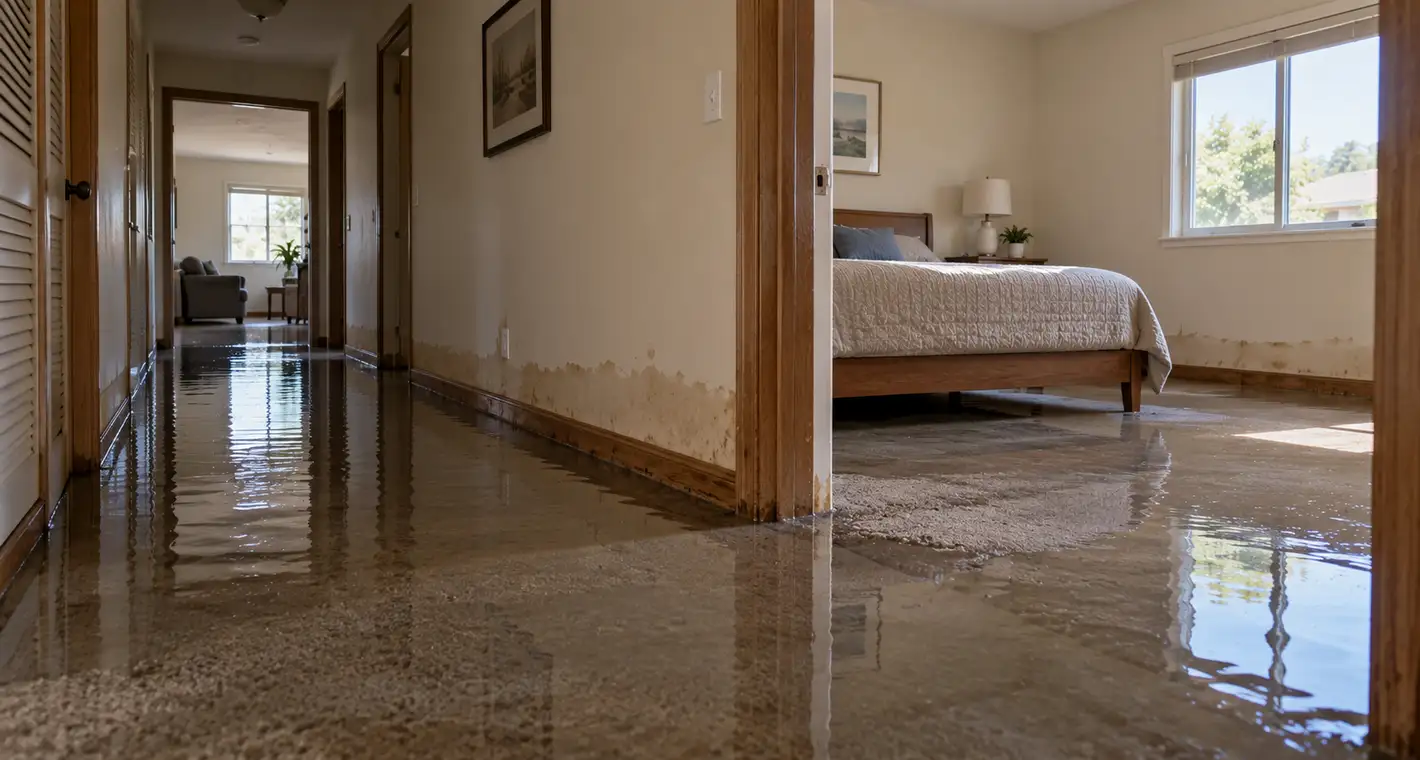
Water damage restoration Compton CA and a city built in three waves
Compton is flat ground north of Carson, drained by Compton Creek, which runs south through the city to the Los Angeles River. Like the rest of the Dominguez lowland it has almost no natural fall, so surface water depends entirely on the storm drain network rather than on gravity finding a channel. This is the oldest housing of the nine cities and the only one with a substantial pre-war core: 9.4 percent was built before 1940, another 20.7 percent in the 1940s, and 28.5 percent in the 1950s. The median year is 1957. That means raised wood floors from the pre-war blocks standing a street away from post-war slabs.
Before help arrives
- Shut the water off at the fixture or the main if you can reach it safely.
- Keep out of any room where water has reached outlets, cords, or the electrical panel.
- Lift furniture off wet carpet and move what you can to a dry floor.
- Photograph the damage and the failure point before anything is moved.
- Do not use a household vacuum to pick up standing water.
Burst pipe cleanup Compton: four failures in older stock
Pre-war raised floors beside post-war slabs
Almost a third of Compton housing predates 1950, and houses of that age were framed over a ventilated underfloor area rather than poured on grade. A supply line letting go in one of those runs down between the joists and sits there. Nothing appears on the finished floor for days, and by the time it does, the subfloor and the framing have both been wet the whole time.
Supply and drain lines past seventy
With 58.6 percent of the stock finished before 1960, a large share of Compton houses still have original galvanized supply or first-generation copper, and cast-iron or clay drains out to the street. Galvanized fails from the inside as the zinc goes and the steel rusts; the pipe narrows for years before it opens up, and then it opens up all at once.
Street flooding and the drain network
The city has recognized that its stormwater system can be overwhelmed in urbanized residential areas, and its Center Avenue green street project was built specifically to capture and treat flow that would otherwise add to existing flooding. Water standing in a street finds its way into garages and under thresholds long before anything is officially a flood.
Richland Farms and agricultural zoning
Richland Farms is zoned for agriculture inside the city, with livestock, horses and outbuildings on residential lots. That means long buried hose runs, barn taps, automatic waterers and irrigation lines on the same parcel as the house. A line that opens up out there will run all night, and the first sign is usually the water bill rather than anything indoors.
Ceiling leak repair Compton and drying a raised floor
Two foundation types in one city means two different jobs. Under a raised floor, water collects out of sight below the joists and keeps feeding the boards above from underneath, so the underfloor area has to be opened and dried on its own. On the post-war slabs the water stays above the concrete and wicks up into the drywall instead. Reading the house before setting equipment matters more here than anywhere else on this list.
Services available in Compton, CA
- Water Extraction & DryingStanding water removed and the structure dried under daily moisture readings.
- Slab Leak DamageWater from a supply line under a concrete floor, traced and dried out.
- Sewage CleanupContaminated water handled with containment, removal and cleaning.
- Mold RemediationGrowth that established after water sat longer than it should have.
Emergency water removal Compton and the areas covered
Providers cover Compton and the streets around it, including Richland Farms, Sunny Cove, Leland, Downtown Compton, West Compton, Rancho Dominguez, East Rancho Dominguez and Willowbrook.
ZIP codes covered for Water Damage Restoration Compton, CA: 90220, 90221, 90222.
Mold remediation Compton: questions homeowners ask
- Should I turn off the electricity?
- If water has reached outlets, cords, appliances, or the panel itself, treat the area as unsafe. Only shut off the breaker if you can reach the panel without standing in water and without touching anything wet. If you cannot reach it safely, leave the area and have the utility or an electrician handle it. No amount of property is worth a shock hazard.
- What happens if water sat under the floor for a week?
- Everything above it stays wet, because the underfloor area has no way to dry on its own. The subfloor, the joists and the bottom of the walls all keep drawing from it. That is the situation where drying alone stops being enough and material has to come out, and it is also where growth starts, because the space is dark, closed and holding water at room temperature.
- Are galvanized pipes still in Compton houses?
- In the older blocks, yes. Galvanized steel was standard before copper took over, and where it has never been replaced it is now seventy years old or more. It corrodes from the inside, so the warning signs are low pressure, rust-colored water on first draw in the morning, and pinholes that show up one after another rather than a single clean break.
- Does the age of the house change the drying time?
- It changes what has to be opened. Plaster over wood lath, common in the pre-war stock, holds water very differently from modern drywall and takes longer to give it back. Raised floors need airflow underneath as well as above. A same-day loss in a post-war slab house here still runs three to five days; an older house with a wet underfloor runs longer.
- How do I know whether my house is on a slab or a raised floor?
- Age is the first thing to check in Compton. Houses from before about 1950 were generally built on a raised wood floor, and post-war tract houses were poured on grade. Two other checks: a floor that gives slightly and sounds hollow under foot is almost always raised, and vents low on the exterior wall mean there is an open area underneath.