
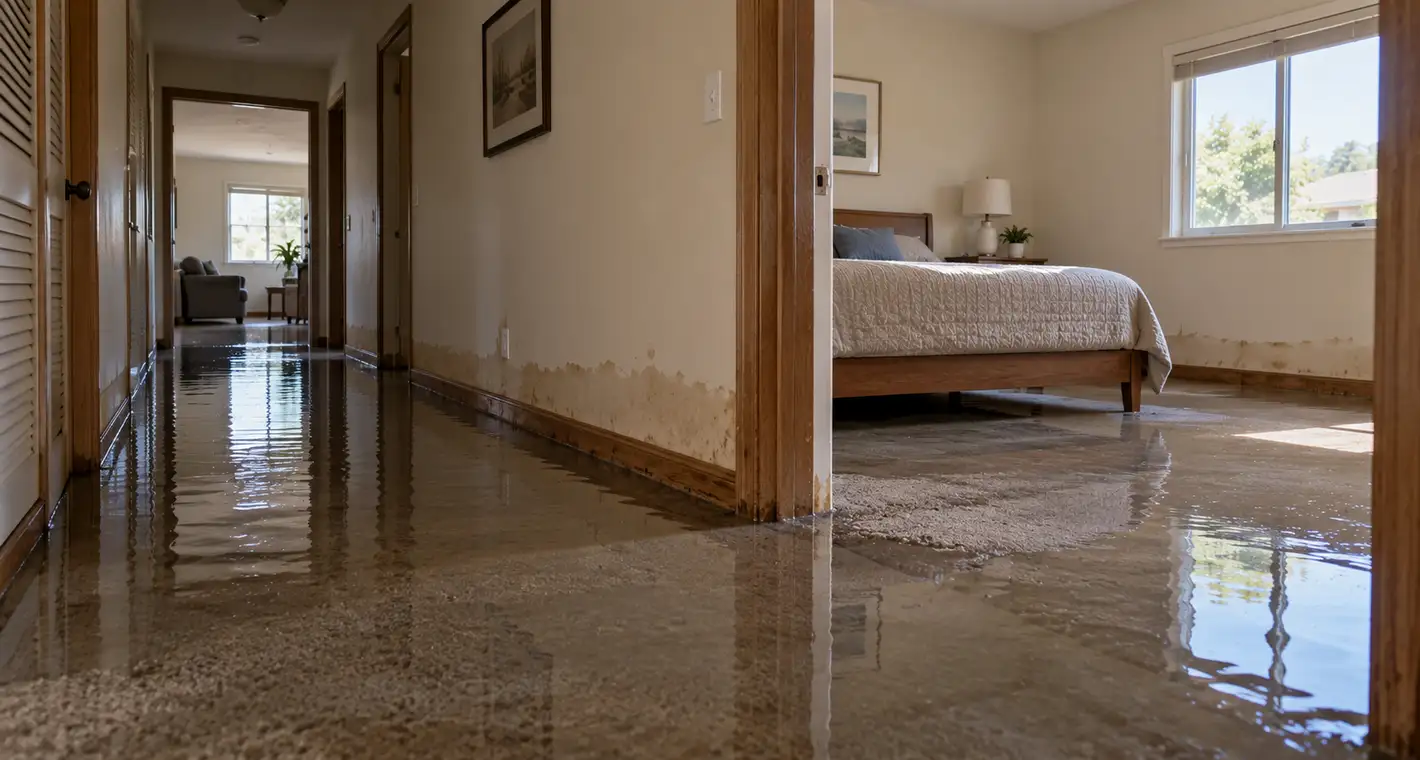
Water damage restoration Torrance CA and two very different grades
Torrance covers two landforms at once. Most of it is the Torrance Plain, dead flat and laid out on a grid, with the El Segundo sand hills along the northwest edge. Along the southern boundary the Palos Verdes Hills come up roughly 445 feet, and the Hollywood Riviera is built on that seaward slope. No other city on this list is as concentrated in one decade: 32.6 percent of Torrance housing was built in the 1950s, and 82.3 percent of it was finished before 1980. The median year is 1964. Flat-side houses are slab-on-grade; on the Riviera slope the same era was built on stepped pads and split levels.
Before help arrives
- Shut the water off at the fixture or the main if you can reach it safely.
- Keep out of any room where water has reached outlets, cords, or the electrical panel.
- Lift furniture off wet carpet and move what you can to a dry floor.
- Photograph the damage and the failure point before anything is moved.
- Do not use a household vacuum to pick up standing water.
Burst pipe cleanup Torrance: what the 1950s stock does
Two grades, two different losses
On the flat north and west sides a failure spreads outward across one level and stops at the walls it soaks. On the Riviera and Walteria slopes the same failure leaves the building: water follows the pad down, gets under the downhill footing, and turns up in a room that is a full floor below the fixture that failed. The two need different equipment and different opening-up.
The oldest copper on the plain
A third of Torrance went up in the 1950s, which makes its original supply piping the oldest on the flat side of this service area. Torrance Municipal Water runs about seven grains per gallon with total dissolved solids near 603 parts per million, and a quarter of the city's supply comes from a West Coast Basin well and the Goldsworthy Desalter rather than from imported water.
Original drain lines at seventy years
Houses of that vintage were drained in cast iron under the slab and clay out to the street. Both are past the age where scale, root intrusion and cracked joints are unusual. A drain that backs up in a slab house has nowhere below to go, so it comes up at the shower pan or the floor drain and puts contaminated water straight onto finished floor.
Second-story additions over a 1950s footprint
Adding a floor to a single-level tract house was common here through the 1980s and 1990s, and it puts a new bathroom stack over framing that was never designed to carry one. The joint between the added supply run and the original one is a recurring failure point, and because it sits inside a wall between two eras of construction, nothing shows until the ceiling below stains.
Ceiling leak repair Torrance and drying between floors
Where a Torrance house has a second floor or a split level, water crosses a floor assembly before anyone sees it, and the ceiling below is the first thing to show. Drying that means opening the ceiling cavity rather than aiming fans at a stain, because insulation above a wet ceiling holds water long after the drywall looks dry. On the flat tract the same loss stays low and spreads sideways instead.
Services available in Torrance, CA
- Water Extraction & DryingStanding water removed and the structure dried under daily moisture readings.
- Slab Leak DamageWater from a supply line under a concrete floor, traced and dried out.
- Sewage CleanupContaminated water handled with containment, removal and cleaning.
- Mold RemediationGrowth that established after water sat longer than it should have.
Emergency water removal Torrance and the areas covered
Providers cover Torrance and the streets around it, including Old Torrance, North Torrance, West Torrance, Southwood, Seaside Ranchos, Walteria, Hollywood Riviera and El Nido.
ZIP codes covered for Water Damage Restoration Torrance, CA: 90501, 90503, 90504, 90505.
Mold remediation Torrance: questions from local homeowners
- Should I turn off the electricity?
- If water has reached outlets, cords, appliances, or the panel itself, treat the area as unsafe. Only shut off the breaker if you can reach the panel without standing in water and without touching anything wet. If you cannot reach it safely, leave the area and have the utility or an electrician handle it. No amount of property is worth a shock hazard.
- Why do 1950s Torrance houses keep having the same failure?
- Because the whole neighborhood was plumbed in the same week with the same material. When the original copper in one house reaches the point where the wall thickness gives out, the houses on either side are within a year or two of it. Streets built in a single tract tend to produce clusters of supply-line failures rather than isolated ones.
- Does hard water have anything to do with pipe failure here?
- It is one factor among several. Torrance water runs around seven grains per gallon, and decades of mineral-heavy water leaves scale inside copper that changes how the pipe wears from the inside. Outside the pipe, contact with concrete and soil does its own damage. Neither causes a leak on its own, but both shorten the working life of a sixty-year-old supply line.
- Can drying equipment run overnight in a Torrance house?
- Normally yes, and it usually has to. Air movers and dehumidifiers work by keeping air moving continuously across wet material, and shutting them off at night adds days to the job. They are loud rather than dangerous. If the loss involves contaminated water or the electrical system, staying elsewhere is the safer call.
- Is the Hollywood Riviera handled differently from the flat side?
- Yes, because the water goes somewhere else. A slope lot puts the failure above a graded pad, and water tracks along the pad and under the downhill side of the house rather than pooling where it started. That means checking the level below the loss and the exterior grade before assuming the damage is contained, and it usually means more equipment for the same amount of water.